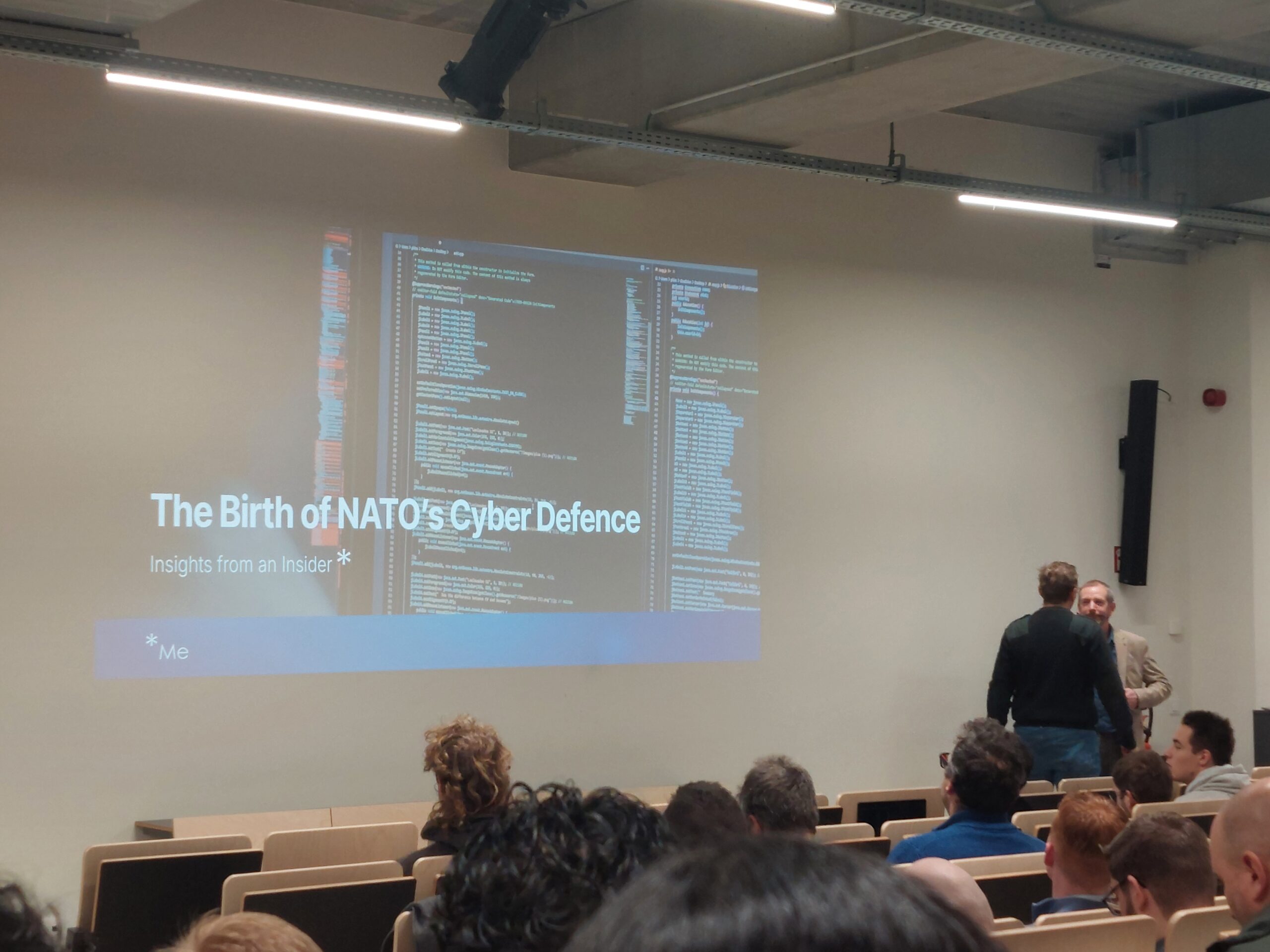
On 2nd December I attended a Tech & Meet session titled “The Birth of NATO’s Cyber Defence: Insights from an Insider,” presented by Martin De Pauw. His background made him a rare speaker to hear from: he graduated from the Royal Military Academy, started his career in F-16 avionics, moved into software, hardware and networks, and was eventually given responsibility for helping co-create cyberspace within the NATO context. He still works at NATO Headquarters in IT and cyber today.
He framed the talk around a shift I’ve heard echoed elsewhere but rarely from someone so close to it: cyber used to be seen as a niche for “nerds and techies,” and is now everyone’s reality. He walked us back to 2016, the year NATO officially recognised cyberspace as a domain of operations alongside land, sea and air, and traced the Alliance’s path from digital uncertainty toward genuine cyber resilience across its 32 nations.
What stuck with me
A big theme was regulation, which is easy to overlook when you’re focused on the technical side. He stressed how important frameworks like NIS2 and the Cyber Resilience Act have become, and why compliance is now part of the security picture rather than separate from it. That connects directly to the GDPR and compliance work I’ve done in my own coursework.
The other thread was the rise of AI in offensive operations including attacks that misuse capable AI models, and the reality that powerful tools get exploited and turned against the systems they were meant to help. His point that “everything is now a computer” landed well: a modern aircraft, as he put it, is essentially a flying computer, and that means everything needs to be tested as if you were the attacker. As a cybersecurity student that attacker’s-mindset framing is something I want to carry into my own work.
It was a genuinely inspiring evening that tied technology, strategy and global security together, and hearing it from someone who was actually in the room for NATO’s early cyber decisions made it memorable. I’d recommend it to anyone curious about cybersecurity on a national scale.